Skip to content
MD-4

MD-4 · Mindful Dive Instructor™

Teaching and assessing the standard.

Sixteen modules: orientation, then fourteen on instructor identity and ethics, instructional design, teaching presence inside dive safety, wellbeing science in teachable language, scuba-safe breath education, the four-phase session, inclusive facilitation, demonstration and feedback, psychological safety, competency decisions, measurement ethics, quality assurance, instructor wellbeing and ocean contribution — plus the supervised Teaching Practicum, assessment and certification.

  • ≈ 12–14 h
  • 4 teaching dives

The e-learning issues a knowledge-complete credential. Full instructor certification is completed through the supervised Teaching Practicum — observed lessons, a teaching portfolio and sign-off — with an Instructor Trainer or Mindful Diving Center™.

Read the FAQ

MD-4

Start here

Teach practical mindful diving skills through clear objectives, demonstration, supported practice and observable assessment. Keep instruction within your qualifications and the Institute’s standards.

What you will be able to do

  • Design an accessible lesson linking an objective, a diving scenario and an observable skill.
  • Teach scuba-safe attention and communication without breath manipulation or clinical claims.
  • Give specific feedback, assess demonstrated competence and document justified decisions.

How the course works

16 chapters · 50 practical readings and tools. Allow additional time for exercises, portfolio work and supervised assessments.

Read the objective, practise the steps and try a scenario with explained feedback. These practice checks do not affect your grade. Further reflection and the original lesson audio are optional. Study at your own pace; agree the practical schedule with your centre.

Rehearse spoken phrases on land. Underwater, use the trained signals you agreed before entry.

What you need to complete

Complete all lessons and answer every chapter-check question correctly; retries are allowed. The practical guide does not replace the exam or supervised evidence.

Final exam: 90% and every safety-critical question correct. If you pass with any wrong answers, you walk each missed item and acknowledge it before the credential is issued. Attempts are unlimited.

Four supervised teaching dives and a signed instructor assessment, with the required teaching evidence.

Anyone may delay, skip or end a dive at any time, without shame and without having to justify it. If your buddy signals to end, confirm and end together following the plan.

Safety boundary. Your dive plan, limits and agency procedures take priority. On scuba, breathe naturally and continuously as trained, without breath-holding or imposed patterns. Breathing difficulty requires trained safety procedures; it must not be treated as simply an emotion. This course is not therapy and does not extend your diving qualifications.
Practical plan: goals and checklist for each dive

Teaching dive 1 — Microteaching & claim language

Learning goal: Teach one approved concept clearly and within scope.

Before entry: Trainer approves the MD1/MD2 concept, real learners, plan, one cue and observation rubric before entry.

Checklist — what to observe and record
  1. One MD-1 or MD-2 concept taught within an approved dive plan.

    Observed evidence: Observe the candidate teach the approved concept to real learners within the agreed dive plan; identify what the learner can now do.

  2. Claims stated without overreach; evidence language reviewed.

    Observed evidence: Note the exact explanation used; check it avoids clinical promises, unsupported claims and scope expansion.

  3. One clear cue only — no cognitive overload.

    Observed evidence: Observe one clear cue and the learner response; note whether the candidate simplifies when the cue adds load.

  4. Rubric completed with observable evidence.

    Observed evidence: The trainer records an observable example and rating for each relevant published rubric domain, not a general impression.

Teaching dive 2 — Scuba-safe breath & inclusive facilitation

Learning goal: Protect normal scuba breathing, access and task priorities while teaching.

Before entry: Confirm learner access needs privately, agreed adaptations, ordinary breathing boundary and exact cancellation conditions.

Checklist — what to observe and record
  1. Breathing kept continuous as taught by the diver's agency; no breathing technique or attention exercise added underwater.

    Observed evidence: Observe instruction that preserves ordinary continuous agency-trained breathing; no added breathing technique or underwater attention exercise is offered.

  2. No practice element introduced during a task-critical phase.

    Observed evidence: Observe optional teaching withdrawn before descent, ascent, gas management or any emerging problem requires attention.

  3. Access considerations named and accommodated.

    Observed evidence: Observe the agreed access adaptation and whether the learner can use the cue; record the adaptation, not a diagnosis.

  4. Instructor kept control of the dive environment throughout.

    Observed evidence: Observe trainer/candidate supervision, spacing and control of the teaching area; record any intervention and what must be re-observed.

Teaching dive 3 — Teaching inside the dive plan

Learning goal: Adapt teaching to learners without leaving the approved dive plan.

Before entry: Before entry, approve the observable outcome, primary tasks, optional elements, cancellation trigger, signals and support roles.

Checklist — what to observe and record
  1. Observable outcome, primary tasks and optional elements stated before entry.

    Observed evidence: Ask the candidate to state what learners should demonstrate and which dive tasks take priority; check the plan matches that statement.

  2. Exact cancellation trigger named; signals and support roles confirmed.

    Observed evidence: Have candidate and support team explain the exact cancellation trigger, signals and responsibilities before entry.

  3. Learner responses observed and instruction adapted early.

    Observed evidence: Observe a learner response and a timely adjustment, simplification or cancellation; never add load to force an adaptation.

  4. Debrief and evidence recorded the same day.

    Observed evidence: Check the same-day debrief and observation record link the learner response, teaching decision and next action.

Teaching dive 4 — Capstone session & assessment

Learning goal: Deliver the capstone and complete the formal practical assessment.

Before entry: Trainer confirms design review has resolved safety, scope and assessment gaps; agree the full session and assessment plan.

Checklist — what to observe and record
  1. Session plan approved at design review with no unresolved safety, scope or assessment gaps.

    Observed evidence: Check the approved session plan and design-review record before delivery; unresolved gaps require revision before entry.

  2. Four-part arc delivered with timing and transitions.

    Observed evidence: Observe the complete four-part arc with real students, timing, transitions and adaptations; also complete the required full land briefing and debrief assessment.

  3. Practical competency matrix completed by the assessor.

    Observed evidence: The authorised trainer completes the published practical competency matrix with ratings, dated examples and any further-practice requirements.

  4. Certification decision rule applied and recorded.

    Observed evidence: Apply and record the existing decision rule, signed practical assessment, MD5 trainer review and Institute countersignature/Standards Council review. A completed card alone does not issue a credential.

Published practical matrix: 12 domains

  • Professional identity and scope
  • Learning design
  • Safety integration
  • Evidence communication
  • Inclusive facilitation
  • Teaching and coaching
  • Adaptation and judgment
  • Assessment integrity
  • Measurement ethics
  • Quality assurance
  • Instructor wellbeing
  • Ocean and center impact

For each domain record: not yet reliable / developing / reliable, evidence, conditions and prompting. A safety-critical criterion that is not yet reliable requires remediation and reassessment; other strengths cannot compensate.

Use your invitation or course code

A personal invitation, centre place or Institute gift starts here. Sign in first, then enter the code from your email. No payment is needed to redeem it.

Center-sponsored codes share your name, progress and credential with the sponsoring center. A personal Institute invitation does not create a center affiliation. Your code opens only its included courses; practical sessions and assessments are arranged separately.

If your invitation includes books, use its download links or open Your books in the learning dashboard.

Your learning, at your pace

You do not have to feel calm or share anything personal to belong here. Pause whenever you need.

  1. Read or listen

    Choose a comfortable text size or listen to the lesson. Reading settings let you adjust the space.

  2. Pause and reflect

    Take what feels useful into everyday life. Personal reflection can stay on paper; follow the course guidance for any required portfolio.

  3. Check and continue

    Try the module scenarios and read the feedback. Revisit a lesson whenever you need, then continue to the next module.

Optional study music

From online access to certification

Your purchase activates the included learning. Certification requires completed learning, verified practice and the applicable assessment; attendance alone is not enough. PRO affiliation and teaching authorization are separate.

MD-4: 4 supervised water sessions in the published pathways.

What to agree with the center and PRO
  • MD-4: Confirm the preceding levels and active agency instructor rating; agree an authorized Instructor Trainer, Teaching Practicum, portfolio and sign-off with MDI.

Ask for a breakdown of online learning, instruction, logistics, taxes and extras; confirm who collects payment, the authorized instructor and weather/cancellation terms. If the package already includes your course, do not buy it again. Use your individual email for access and records.

The MD-1 to MD-3 certification fee is included for eligible center enrollments assessed by that center’s active, authorized PRO. Teaching is agreed separately.

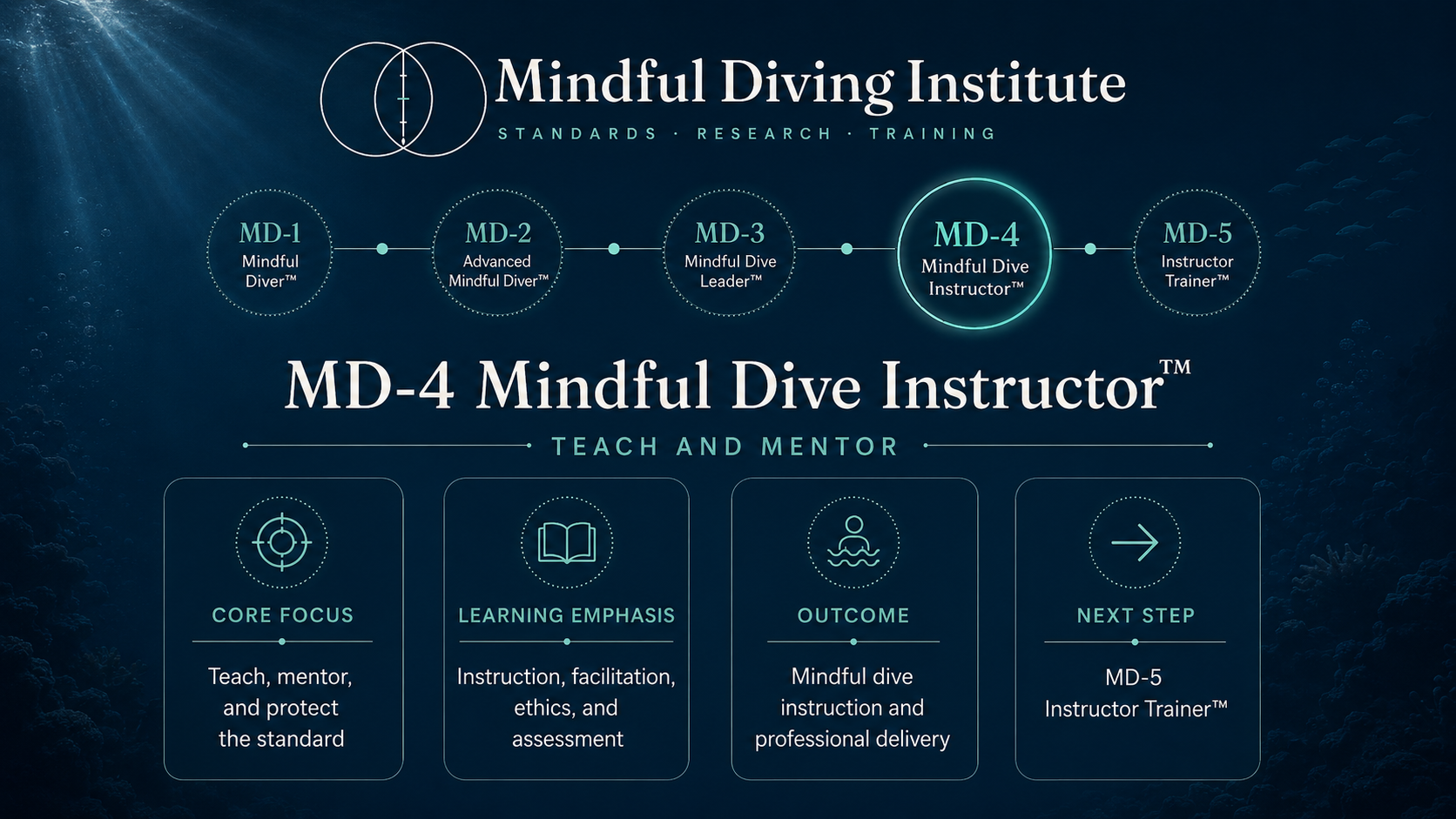
MD-4 level overview in the Mindful Diving Institute five-level pathway: core focus, learning emphasis, outcome and next step.

Modules

Loading…

Safety first

On scuba, breathe naturally and continuously as trained; never hold, skip or deliberately restrict your breathing. Keep attention on your buddy, buoyancy, gas and surroundings. Leave optional exercises out of descents, ascents and any demanding task.

Keep every practice within your training, agency standards and dive plan. Emergency procedures take priority. Anyone may decline a practice or end a dive. This is education, not therapy, medical clearance or agency endorsement.

Practice and professional scope

Complete the learning and assessments, then check your course's water verification, practicum and approval requirements. A completion record and professional teaching authority are different outcomes.

Mindful Diving Institute

Explore related learning

Choose what you want to practise next. Everything here is optional; you can also revisit your course or use a free practice.

Prices cover online learning. Agree water sessions, practical assessment and professional affiliation costs separately before enrolling.

MD-5

Instructor Trainer™

Develop instructor mentoring, assessor calibration and evidence-based programme review within the trainer pathway.

  • ≈ 14–16 h
  • supervised cohort

MD-5 requires certified MD-4, at least one year teaching that level, an agency instructor-trainer or course-director rating, and an invitation from the Standards Council. Online access is not authorization.

€555

Course details and prerequisites

MB-G

Mindful Breath Guide™

Learn to facilitate bounded breathing-awareness sessions, with consent, observation and assessed practice.

  • ≈ 9–11 h
  • 2 assessed sessions

Mindful Breath Guide requires MD-1 or equivalent mindful-diving training, plus an active professional diving rating or a recognized breath-teacher qualification.

€222

Course details and prerequisites

DM-F

The Diving Mind

Explore fear and doubt, rehearse a conversation and write your own dive-day plan.

  • ≈ 4 h
  • online only · no water sessions

€55

Course details and prerequisites

Guide and instructor programs have additional prerequisites and observed assessments. Buying a course does not grant teaching authority.

Prices cover online learning. Agree water sessions, practical assessment and professional affiliation costs separately before enrolling.