Free reference · Mindful Diving Institute
Scuba diving hand signals
The signals below are the ones divers actually use. They are a reference, not a standard: your agency training and your pre-dive briefing decide what you use in the water. Agree them with your buddy before every dive — including the ones you think are obvious.
Opens your print dialog — choose “Save as PDF”. Sized for A4.
This page is complementary to, and never a substitute for, the safety standards and training of SSI, PADI, CMAS, RAID and other agencies. Signals are agreed in the briefing. Never use mindfulness practices during task-critical phases, and never breath-hold on scuba.
The essential five
Agreed before every dive, by every diver, in every language.
How
Thumb and index finger joined in a circle, the other three fingers extended. With gloves or at distance, arm over the head in a circle.Means
Both a question and an answer. Asked, it must be answered — silence is not an OK.When
After the descent, at every depth change and whenever your buddy asks.Common mistake
Answering with a thumb up. Underwater, thumb up means ascend, never OK.How
Flat hand, palm down, rocked side to side, then point at what is wrong.Means
Something is off. Say it early, at amber, not late at red.When
The moment something feels off: mask, gear, ears, breathing or mood.Common mistake
Rocking the hand without pointing at the problem. Always follow with where.How
Closed fist, thumb up.Means
An instruction, not an opinion. Any diver may end any dive, at any time, without giving a reason.When
At the planned end of the dive, at turn pressure, or any time a diver wants to stop.Common mistake
Treating it as a suggestion to discuss. It is answered with OK and a controlled ascent.How
Closed fist, thumb down.Means
Begin or continue the descent, at the agreed rate.When
At the start of the descent, once everyone has given OK at the surface.Common mistake
Descending before the buddy answers. Wait for the OK, then go down together.How
Flat open palm facing the buddy.Means
Stop adding tasks and stabilise here. The most under-used signal in diving.When
When the group spreads out, a task piles up or someone needs a moment.Common mistake
Confusing it with slow down. Stop means hold position, not just ease off.
Gas and pressure
Numbers vary by agency and by region. Agree yours on the surface.
How
Flat hand tapped twice against the open palm of the other hand, or two fingers to the palm.Means
Answer with numbers, honestly and immediately.When
Regularly through the dive, and always before turning or starting the ascent.Common mistake
Guessing instead of reading the gauge. Look, then show the number.How
Flat hand held horizontally at chest height, or the agreed number shown on fingers.Means
The turn point of the dive plan has arrived.When
When you reach the pressure agreed as the turn point.Common mistake
Assuming everyone shares one convention. Agree the numbers at the briefing.How
Closed fist to the centre of the chest.Means
Reserve reached. Begin the ascent plan now, together.When
When you reach reserve pressure, before it becomes urgent.Common mistake
Waiting to be asked. Give it yourself, as soon as you see the number.How
Flat hand drawn across the throat.Means
An emergency. Follow the out-of-gas procedure you trained with your agency and rehearsed with this buddy.When
Only in a real out-of-gas emergency, immediately followed by the share-gas procedure.Common mistake
Swimming away to find the guide. Go to the nearest diver and signal close up.
Direction, depth and pace
Most task-loading happens here. Keep signals slow and single.
How
Two fingers pointed toward your own eyes, then toward the object.Means
Direct your attention here.When
To point out life, a hazard or the guide's position.Common mistake
Pointing with a torch beam in someone's eyes. Point at the object, never the face.How
Palm up, fingers curling toward you.Means
Close the distance to me.When
To bring your buddy closer, to share something or before a check.Common mistake
Beckoning from too far away. Make eye contact first.How
Flat hand held vertically, fingers pointing in the direction of travel.Means
The agreed heading.When
At junctions, turns and when the guide changes heading.Common mistake
Pointing a single finger. A flat hand is clearer at distance and in poor visibility.How
Index finger raised and circled, then both palms turned up.Means
I am not sure of the route. Show me the way.When
When you are unsure of the route or have lost the reference.Common mistake
Carrying on in silence. Asking early costs nothing.How
Flat hand, palm down, pressed gently downward.Means
Reduce pace and workload. Almost always the right answer.When
When the pace, breathing or group spread starts to rise.Common mistake
Making the hand move fast. Show slow with a slow hand.How
Flat hand, palm down, held steady and horizontal.Means
Hold this depth.When
When a buddy drifts deeper or shallower than planned.Common mistake
Confusing it with half tank. Context and the briefing tell them apart.How
Three fingers raised over a flat horizontal hand: three minutes, five metres.Means
Follow the stop depth and duration in your training, dive plan and computer guidance. Maintain buoyancy, monitor gas and stay with your buddy. A stop is part of the ascent; do not add breathing exercises or close your eyes.When
At the end of the ascent, usually 3 minutes at 5 metres.Common mistake
Cutting it short because the boat is close. Hold the full time.How
Index finger pointing up, circled horizontally.Means
Turn around and head back along the planned route.When
At turn pressure, the turn time or whenever the plan says go back.Common mistake
Turning alone. Confirm the buddy has seen it and answered OK.How
Two index fingers held side by side.Means
Close the distance and dive as a pair.When
When the pair drifts apart or the group gets strung out.Common mistake
Staying together in name only. Within reach is the working distance.How
Both hands clasped together, fingers interlocked.Means
Let's hold on to each other.When
In current, low visibility, or to reassure a nervous buddy.Common mistake
Gripping too hard. A light hold still leaves both of you free to act.
Problems and the body
Naming a small problem early is the whole skill.
How
Point to the ear.Means
Equalisation is not working. Stop the descent, ascend slightly, try again gently. Never force.When
During descent, when equalisation stops working.Common mistake
Continuing down hoping it clears. Stop, rise a little, try again gently.How
Arms crossed over the chest, hands rubbing the upper arms.Means
Thermal reserve is going. Cold is a common quiet cause of anxiety and short dives.When
When shivering starts or your hands lose feeling.Common mistake
Staying quiet to finish the dive. Cold makes every other task harder.How
Two fists brought together and pulled apart.Means
Stop, stretch, let the buddy help.When
When a calf or foot cramps while finning.Common mistake
Kicking through it. Stop, stretch and let the buddy steady you.How
Flat hand moved slowly up and down in front of the chest.Means
On scuba, breathe naturally and continuously as trained; never hold, skip or deliberately restrict your breathing. Keep attention on your buddy, buoyancy, gas and surroundings. Leave optional exercises out of descents, ascents and any demanding task.When
When a buddy's bubbles come fast or their eyes look wide.Common mistake
Notice your breathing without imposing a rhythm. In the water, keep breathing naturally and continuously as trained, with attention available for diving tasks.How
Index finger circled beside the head.Means
Hold on to something stable, hold depth, signal the buddy and end the dive if it persists.When
When you feel dizzy or lose the sense of up and down.Common mistake
Moving fast to fix it. Hold something stable and watch the bubbles.How
Forearm raised, fist clenched, then point to the hazard.Means
Something here can hurt us. Keep clear.When
For current, fishing line, boat traffic or a hazardous animal nearby.Common mistake
Signalling danger without pointing. Always show where it is.
At the surface and the boat
At distance, the whole arm speaks. Keep these big and clear.
How
One arm over the head, fingertips touching the top of the head.Means
I am fine, for the boat or a buddy at distance.When
At the surface, to tell the boat you are fine at a distance.Common mistake
Waving to say hello. At the surface, a wave means help.How
One arm waved slowly from side to side above the water.Means
I need help. Come and get me.When
Only when you need help or pickup at the surface.Common mistake
Using it casually. Crews respond to it as an emergency.How
Both hands cupped together like the hull of a boat.Means
Boat overhead, or back to the boat.When
To show a boat overhead or to agree where the boat is.Common mistake
Ascending under the sound of engines. Listen, look up and use your marker.
Marine life
These vary most between sites. Confirm them at the briefing, then point, look and let the animal be.
How
One hand flat on the back of the other, thumbs circling like flippers.Means
A turtle is here.When
When a turtle is resting, feeding or passing.Common mistake
Blocking its way to the surface. Turtles must breathe; stay aside.How
Fingers pointing down from a fist, wriggling like arms.Means
An octopus is here.When
To show an octopus in a crack or on the move.Common mistake
Touching or poking the den. Look, don't reach.How
Both flat hands overlapped, flapping slowly like wings.Means
A ray on the sand, or an eagle ray in open water.When
For rays on the sand or eagle rays passing in season.Common mistake
Swimming over a ray on the bottom. Give it space and keep off the sand.How
Hand opening and closing slowly, like a mouth.Means
A moray is in that hole.When
To show a moray in its hole.Common mistake
Putting a hand near the hole. The open mouth is breathing, not a threat.How
Flat hand held vertically in front of the chest, chopped sideways.Means
Barracuda, alone or in a school.When
For a single barracuda or a school in open water.Common mistake
Confusing it with the shark signal. Horizontal chop, not a fin on the head.How
Hand cupped under the chin, fingers opening like a big mouth.Means
A grouper is nearby.When
For groupers (mero) at their stations on the shoals.Common mistake
Assuming one sign. Grouper signs vary by region; check at the briefing.How
Index and middle finger raised and flexed at the forehead, like antennae.Means
A lobster is in that crack.When
When antennae show from a crack or ledge.Common mistake
Pulling it out to show others. Point and let it stay.How
Two fingers raised on the back of the other hand, which crawls slowly.Means
A nudibranch here. Come close, slowly.When
For the small slugs that reward slow, close looking.Common mistake
Finning hard beside the reef. Settle your buoyancy before you look close.How
Fingers spread and pointing down from the wrist of the other arm, like spines.Means
Venomous spines. Look, never touch.When
For lionfish or scorpionfish, which carry venomous spines.Common mistake
Resting a hand on the reef near one. They sit very still and blend in.
The Water Gallery
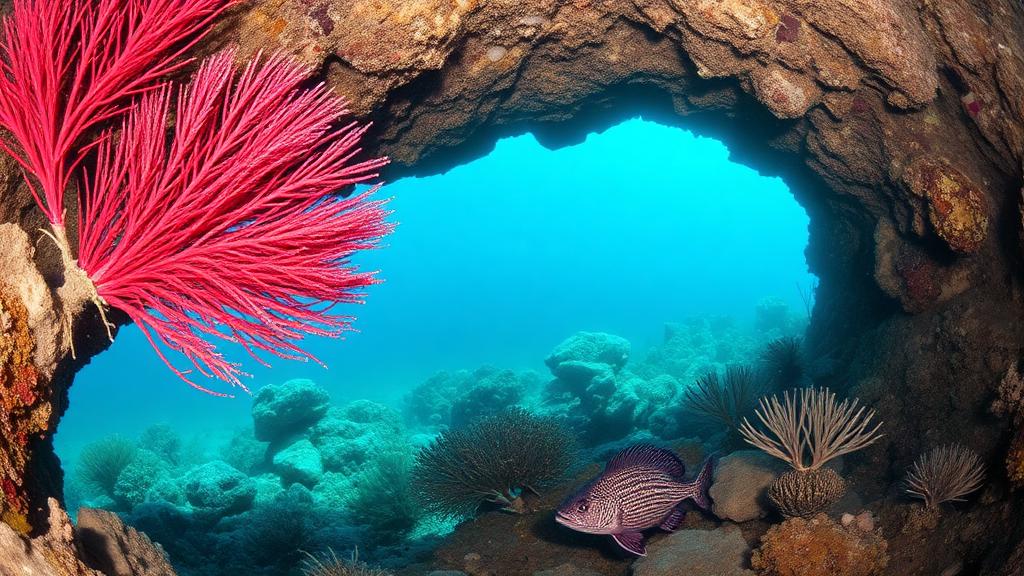
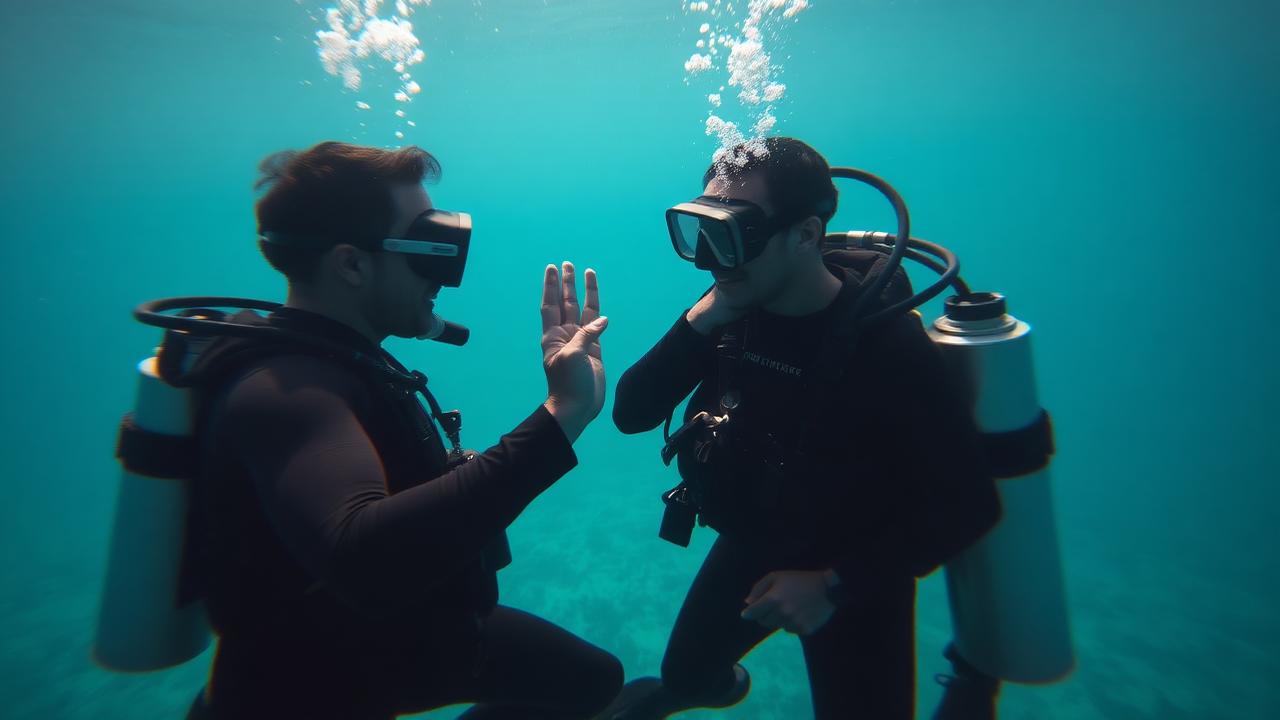
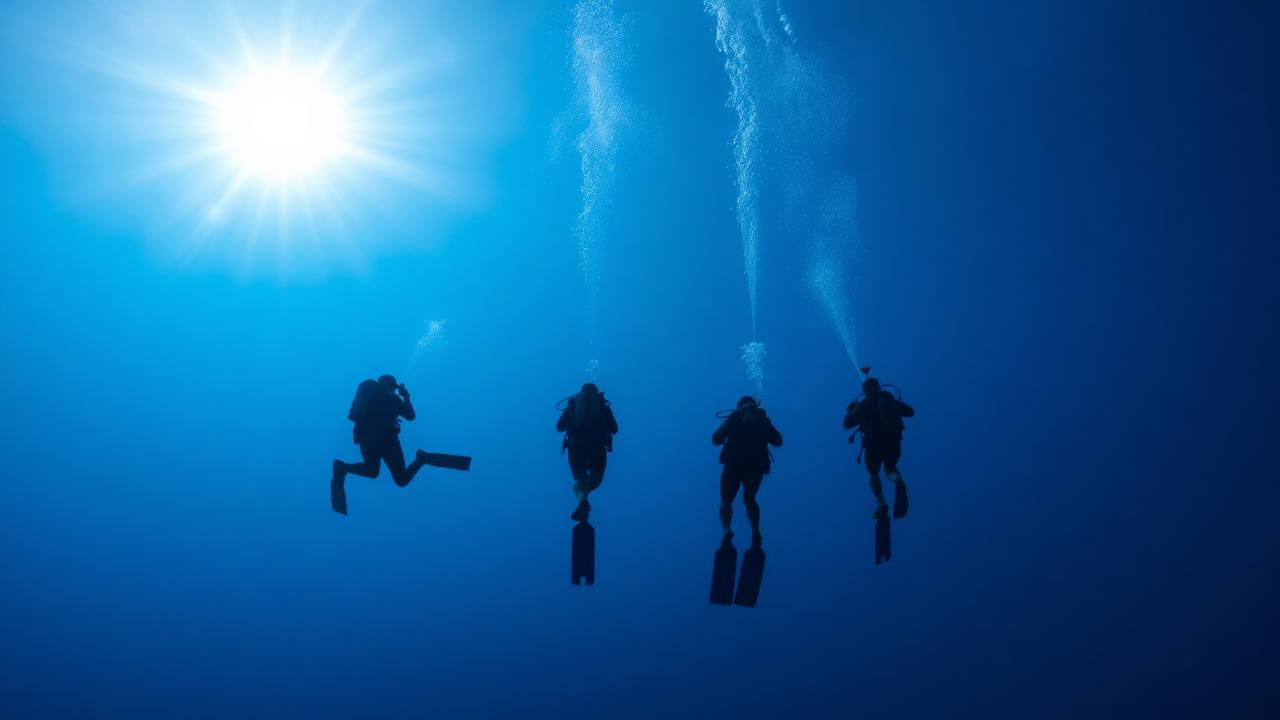
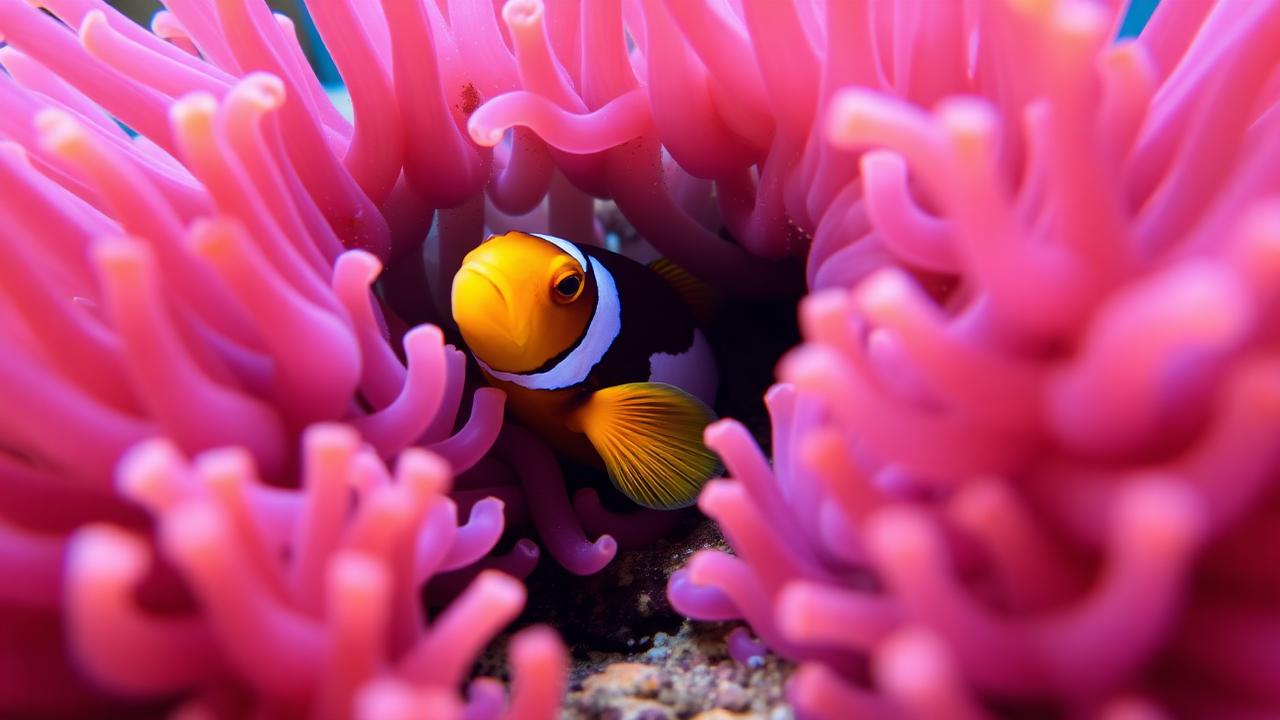
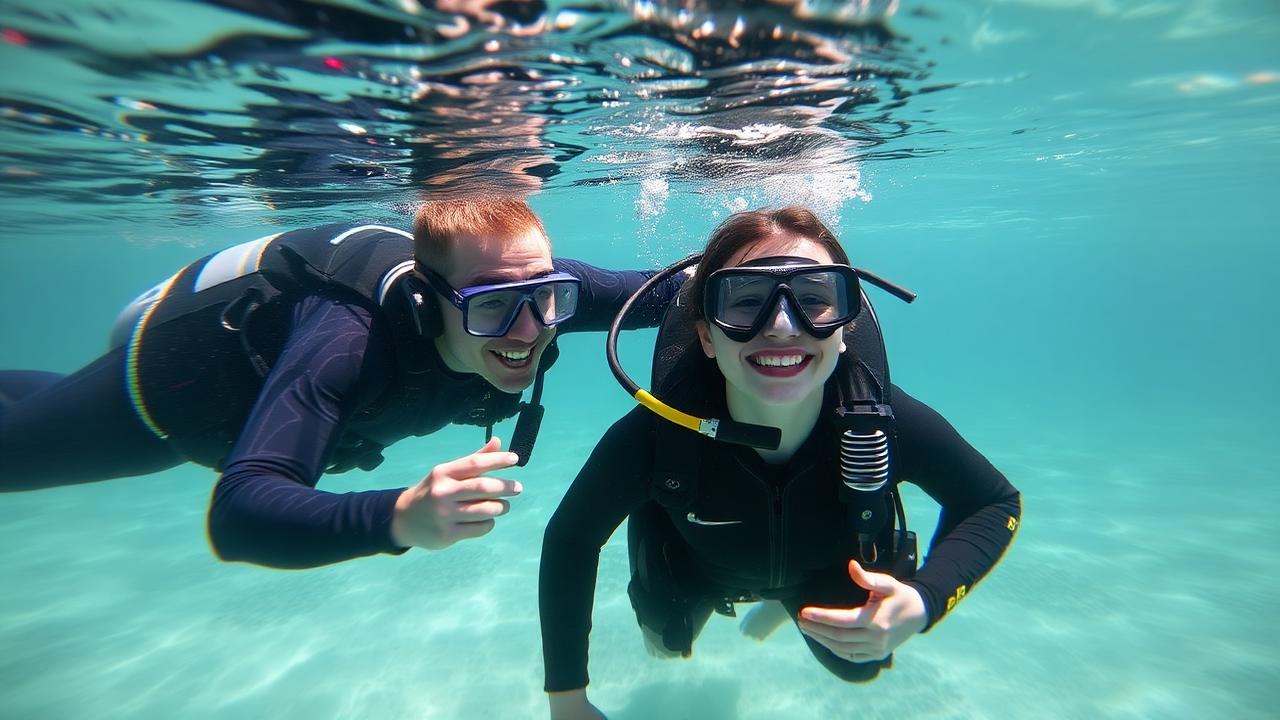
Mindful Diving™ signals — presence underwater
These are the Institute's own signals, complementary to — never instead of — the standard set above. They are agreed at the briefing and practised as part of MD-1.
Standard signal sets are excellent at emergencies and almost silent about the state just before one. These are agreed in the Buddy Agreement before entry, in addition to — never instead of — your agency's signals.
How
Flat hand tilted side to side, then the OK question. Agreed in the Buddy Agreement before entry.Means
I am not in trouble, and I am not fine. Slow down, stay close, check me again in a minute.When
Early, at the first sign of unease, before it becomes a problem.Common mistake
Saving it for emergencies. Amber is for the moment before one.How
Use the hand movement agreed in the briefing; it does not prescribe a breathing rhythm.Means
Notice your breathing without imposing a rhythm. In the water, keep breathing naturally and continuously as trained, with attention available for diving tasks.When
When a buddy's breathing speeds up and there is no emergency.Common mistake
Notice your breathing without imposing a rhythm. In the water, keep breathing naturally and continuously as trained, with attention available for diving tasks.How
Flat palm down held still, then two fingers to the eyes.Means
Hover and observe here for a few breaths.When
At a stable spot on the reef, to hover and observe for a few breaths.Common mistake
Pausing in current or near the ascent. Only where the plan allows it.How
Open palm over the heart, then the OK sign.Means
All good, outside and inside.When
In answer to an OK or amber check, when all is well inside too.Common mistake
Giving it by habit. Take one breath and check before you answer.How
The turn signal, then a flat palm lifted gently toward the buddy.Means
I want to turn back. No reason needed, no pressure given.When
Any time a diver wants to turn back, for any reason or none.Common mistake
Asking why underwater. Turn together; talk on the boat if at all.How
Open palm lowered slowly, held still for one full breath cycle.Means
Nothing is wrong. Take one breath here before the next task. The in-water form of STILL.When
Once stable on the bottom, before the next task.Common mistake
Using it in descent or ascent. Never during task-critical phases.How
Two fingers to the eyes, then held open toward the water rather than at an object.Means
Not a fish or a hazard — the whole scene. An invitation to look wide for a moment.When
In a calm moment, to widen attention from one fish to the whole scene.Common mistake
Reading it as a hazard. It is an invitation, not a warning.
Why hand signals are a mindfulness practice
A signal only works when someone is watching. Every OK asked and answered is a small act of attention: you stop, look at your buddy, and check in with yourself before you reply. On the boat, agreeing signals is part of Before — intention and grounding. In the water, each exchange is a moment of Below: presence with the person beside you, not just the reef. Slow hands, slow breath.
Breathwork for diversFlashcards
One signal at a time. Read the name, picture the hand, then turn the card to check the shape and the meaning.
Quick check
Eight signals, one shape each. Every answer comes with the reason — the meaning matters more than the score.
…
Common questions
What is the most important scuba hand signal?
OK, and the thumb up. OK is both question and answer, and it must always be answered. The thumb up ends the dive: it is an instruction rather than a request, and any diver may give it at any time without a reason.
How do you signal low on air?
A closed fist held to the centre of the chest means you have reached reserve pressure. Give it yourself as soon as you see the number, then begin the ascent plan together. Out of air is different: a flat hand drawn across the throat, followed by the share-air signal.
What does the OK signal mean underwater and at the surface?
Underwater, OK is the thumb and index finger joined in a circle: I am fine, or are you fine? At the surface, and at distance, it becomes one arm over the head with the fingertips touching the top of the head, so the boat can see it. Waving an arm at the surface means help, never hello.
Are hand signals the same in PADI and SSI?
The essential signals — OK, up, down, stop, low on air, out of air — are effectively the same across PADI, SSI, CMAS, RAID and others. Details differ by agency, region and dive site, especially for gas numbers and marine life. That is why the briefing is the final authority: agree your signals with your buddy and guide before every dive.
Is there a printable scuba hand signals PDF?
Yes. Use the “Print / download the cheat sheet” button on this page. It opens a one-to-two-page A4 sheet with every signal, which you can print or save as a PDF from your browser’s print dialog.
Why is thumb up 'ascend' rather than OK?
Because on land the thumb up means approval, and underwater it means end the dive. Confusing the two costs dives and occasionally more. Underwater, OK is always the finger-and-thumb circle, never the thumb alone.
How do I signal that I am anxious but not in danger?
Most standard signal sets have no word for this, which is why divers stay silent until the situation is red. Mindful Diving™ adds an agreed amber signal — not in trouble, not fine — so the pair can slow down and stay close early. It is agreed on the surface in the Buddy Agreement and never replaces an agency signal.
Can I practise hand signals before diving?
Yes, and it is the cheapest safety practice there is. Run through the whole set on land with your buddy, then again with masks on in shallow water. Signals you have rehearsed together arrive faster than signals you have only read.
Where signals become presence.
MD-1 Mindful Diver™ trains the pre-dive agreement, the early signal and the settled response until they are available when they are needed — inside the agency certification you already hold.
Silence has a language.