Four modules across the practice arc — Before, Below, Between, Beyond — plus the 21 Breaths practice cycle: a 21-day guided log. Open to divers of any agency and to complete beginners; MD-1 is recommended, not required. An optional water session can be taken at a Mindful Diving Center™.
You do not have to feel calm or share anything personal to belong here. Pause whenever you need.
Read or listen
Choose a comfortable text size or listen to the lesson. Reading settings let you adjust the space.
Pause and reflect
Take what feels useful into everyday life. Personal reflection can stay on paper; follow the course guidance for any required portfolio.
Check and continue
Try the module scenarios and read the feedback. Revisit a lesson whenever you need, then continue to the next module.
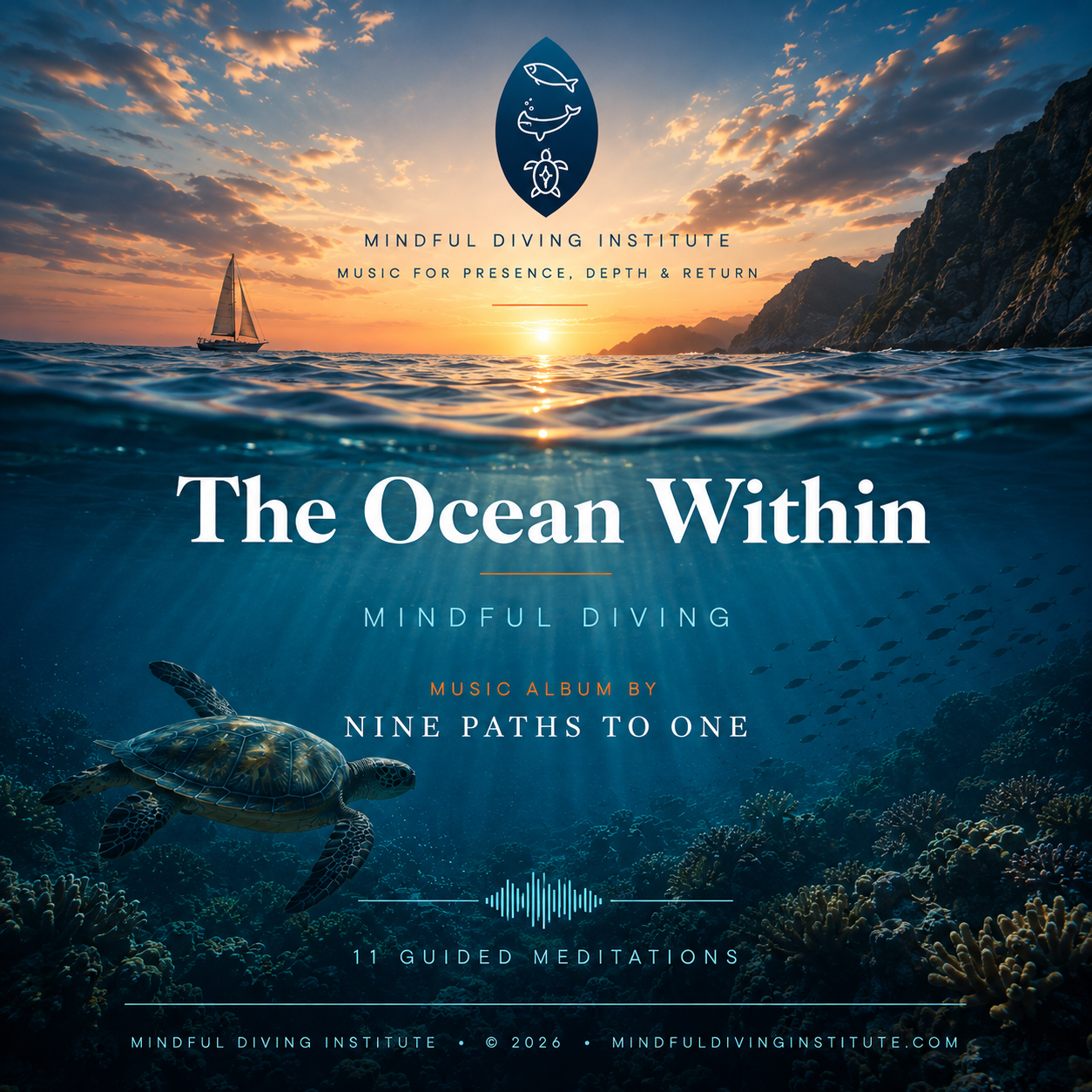
The Ocean Within · Nine Paths to One
The music of belonging
Our music carries the heart of MDI: arrive as you are, meet the ocean with respect, and carry care back into daily life. Technical learning and emotional awareness belong together, with connection to yourself, the water and life.
Listen, read the reflection or spend a moment in silence. There is no feeling to achieve and nothing personal to disclose. Listening is optional and does not affect course completion.
Listen on land, away from diving tasks. Breathe comfortably; you do not need to follow a musical rhythm or hold your breath. You can pause or stop at any time.
Original recordings in English and Spanish; reflections in your chosen language.
Arrive as you are
The first meeting with the ocean begins with how we arrive. Excitement, uncertainty and quiet can all have a place. There is nothing to prove before we can be present.
What am I bringing today, and what would help me feel supported?
Make room for what you feel
Feelings can be noticed without being hidden or forced to change. A moment of listening may help us find words; silence, looking around or asking for support can serve just as well.
What feeling needs room, and what choice or support would help now?
Carry the ocean into the ordinary
The experience continues in the life we return to. An unhurried conversation, a pause before answering or a kinder request for help can carry something of the encounter into an ordinary day.
On scuba, breathe naturally and continuously as trained; never hold, skip or deliberately restrict your breathing. Keep attention on your buddy, buoyancy, gas and surroundings. Leave optional exercises out of descents, ascents and any demanding task.
Keep every practice within your training, agency standards and dive plan. Emergency procedures take priority. Anyone may decline a practice or end a dive. This is education, not therapy, medical clearance or agency endorsement.
Practise breathing exercises on dry land, in a safe place, without forced ventilation or breath-holds. Stop if uncomfortable or dizzy. Do not use intense breathwork to prepare for immersion. No fixed waiting interval makes it safe. Underwater, follow the shared scuba guidance.
A breathing guide for divers
Breathing awareness: on land and on scuba
Notice your breathing without imposing a rhythm. In the water, keep breathing naturally and continuously as trained, with attention available for diving tasks.
By Prof. Luis Miguel Gallardo · Mindful Diving Institute
Last updated:
Why ventilation comes first
Breathing serves gas exchange, not a calmness score. Effort, depth, equipment and health can affect breathing. Reducing ventilation to save gas can allow carbon dioxide to accumulate. Learn efficient movement and buoyancy with your instructor; never ration breaths.
Research on slow breathing in land-based settings does not establish a breathing rate for scuba. Keep land exercises separate from underwater practice; comfort, ventilation and the demands of the dive come first.
On dry land, pause somewhere secure. Notice an ordinary breath, then look around and check in with your buddy. No counting, forced depth or pauses are needed. Keep the equipment check and dive briefing complete.
Practise breathing exercises on dry land, in a safe place, without forced ventilation or breath-holds. Stop if uncomfortable or dizzy. Do not use intense breathwork to prepare for immersion. No fixed waiting interval makes it safe. Underwater, follow the shared scuba guidance.
Underwater: attention for the dive
On scuba, breathe naturally and continuously as trained; never hold, skip or deliberately restrict your breathing. Keep attention on your buddy, buoyancy, gas and surroundings. Leave optional exercises out of descents, ascents and any demanding task.
Diving can feel absorbing, but it also adds demands on attention. Keep checking gas, depth, buoyancy, your buddy and the environment. Feeling calm does not by itself show that a diver is safe or ready.
Talk about concerns before entering the water and agree how to pause or end the dive. Breathing difficulty can have physical causes; do not assume it is anxiety. Underwater, signal your buddy and follow your training and emergency procedures.
Once safely out of the water, share one observation, one concern and one thing to change next time. Listen before interpreting. A useful debrief ends with a specific, realistic action.
Three books. Three ways to deepen your practice.
Mindful Diving develops attention and the wider practice through MD-1 to MD-5. Mindful Breath explores breathing awareness. The Diving Mind explores fear, doubt and decisions. The specialties are optional and purchased separately; none replaces agency training or rescue skills.
Breathing serves gas exchange, not a calmness score. Effort, depth, equipment and health can affect breathing. Reducing ventilation to save gas can allow carbon dioxide to accumulate. Learn efficient movement and buoyancy with your instructor; never ration breaths.
Are timed breathing pauses part of this practice?
Practise breathing exercises on dry land, in a safe place, without forced ventilation or breath-holds. Stop if uncomfortable or dizzy. Do not use intense breathwork to prepare for immersion. No fixed waiting interval makes it safe. Underwater, follow the shared scuba guidance.
Keep every practice within your training, agency standards and dive plan. Emergency procedures take priority. Anyone may decline a practice or end a dive. This is education, not therapy, medical clearance or agency endorsement.