Skip to content
MD-2

MD-2 · Advanced Mindful Diver™

Composure, precision and stewardship.

Eleven chapters to practise attention under task load, buoyancy, low-impact movement, buddy communication and a useful post-dive review. Study online at your own pace; MD-2 certification also requires four supervised water sessions and a portfolio.

  • ≈ 8–10 h
  • 4 dives · portfolio

Read the FAQ

MD-2

Start here

Build reliable attention, early communication and low-impact diving under normal task load. Practise within your existing dive training and limits.

What you will be able to do

  • Recognise rising load and release optional tasks before attention narrows.
  • Maintain depth, gas, buddy and navigation awareness while making measured buoyancy corrections.
  • Use agreed signals, respect a stop decision and debrief one practical improvement.

How the course works

11 chapters · 26 practical readings and tools. Allow additional time for exercises, portfolio work and supervised assessments.

Read the objective, practise the steps and try a scenario with explained feedback. These practice checks do not affect your grade. Further reflection and the original lesson audio are optional. Study at your own pace; agree the practical schedule with your centre.

Rehearse spoken phrases on land. Underwater, use the trained signals you agreed before entry.

What you need to complete

Complete all lessons and answer every chapter-check question correctly; retries are allowed. The practical guide does not replace the exam or supervised evidence.

Final exam: 80% and every safety-critical question correct. Reviewing missed items is offered, not required. Attempts are unlimited.

Four supervised water sessions, verified by the authorised professional, plus the required integration evidence.

Anyone may delay, skip or end a dive at any time, without shame and without having to justify it. If your buddy signals to end, confirm and end together following the plan.

Safety boundary. Your dive plan, limits and agency procedures take priority. On scuba, breathe naturally and continuously as trained, without breath-holding or imposed patterns. Breathing difficulty requires trained safety procedures; it must not be treated as simply an emotion. This course is not therapy and does not extend your diving qualifications.

Practical plan: goals and checklist for each dive

Session 1 — Regulation & flexible attention

Learning goal: Recognise rising task load, release an optional task and communicate early.

Before entry: Check entry requirements without copying medical details; agree a light optional task and a surface rehearsal of task release.

Checklist — what to observe and record
  1. Gates before entry: certification, medical screening and recent-experience check confirmed.

    Observed evidence: Record that certification, screening and recent experience were checked and any required follow-up resolved before entry; do not record diagnoses.

  2. Site, conditions and supervision appropriate; personal early-load cue named.

    Observed evidence: Record the site/conditions/supervision decision and the practical response agreed for an early-load cue; no disclosure of emotions is required.

  3. Flexible attention and early regulation observed under light task load.

    Observed evidence: Observe attention moving between the ordinary dive priorities under light load, with optional activity dropped when necessary. Regulation means reducing load, not controlling breathing.

  4. Task release and closed-loop communication demonstrated.

    Observed evidence: Observe release of the agreed optional task and a signal acknowledged by the buddy. Rehearse on the surface if no safe in-water opportunity arises; label that evidence as a rehearsal.

Session 2 — Precision buoyancy & reef care

Learning goal: Maintain trim and clearance using small technical corrections.

Before entry: Review equipment, weighting and trim with the instructor; select a route suitable for no-contact observation.

Checklist — what to observe and record
  1. Equipment configuration, weighting and trim plan reviewed with the instructor.

    Observed evidence: Have the diver explain the agreed configuration and weighting/trim plan before entry; observe implementation within agency training.

  2. No-contact and local environmental rules confirmed before entry.

    Observed evidence: Ask the diver to identify local restrictions and the planned no-contact route before entry.

  3. Micro-correction, stable trim and spatial awareness observed.

    Observed evidence: Observe a small buoyancy or position correction using trained equipment and movement skills; record its effect on trim and clearance, never a breathing manipulation.

  4. Environmental bubble protected throughout.

    Observed evidence: Observe clearance around fins, equipment, other divers and wildlife throughout the route; note one anticipatory adjustment or maintained safe spacing.

Session 3 — Team safety & stop authority

Learning goal: Make speaking up and stopping usable for the whole team.

Before entry: Brief a benign stop-signal rehearsal and roles on land. No surprise emergency, induced anxiety, gas restriction or equipment fault.

Checklist — what to observe and record
  1. Closed-loop communication used in a realistic team scenario.

    Observed evidence: Observe a message, acknowledgement and appropriate response in the agreed team scenario; distinguish surface rehearsal from in-water observation.

  2. Psychological safety held: any diver may speak without cost.

    Observed evidence: Observe the invitation to speak up and the team response to a request or opt-out, without pressure, ridicule or demand for justification.

  3. Stop authority exercised or acknowledged and stabilised before questions.

    Observed evidence: Observe the agreed stop signal acknowledged and the group stabilised before discussion. Use a safe planned rehearsal; never manufacture a hazard.

  4. Debrief opened with facts, closed with an owned action.

    Observed evidence: After recovery, record one factual event, its effect and the next action with a named owner; personal emotional disclosure remains optional.

Session 4 — Full arc under normal complexity

Learning goal: Integrate the MD2 skills and support the rubric with evidence.

Before entry: Review the published rubric and portfolio requirements; agree a normal dive and one stewardship behaviour.

Checklist — what to observe and record
  1. The full MD-2 arc integrated under normal complexity.

    Observed evidence: Observe the full sequence: readiness/buddy preparation, safe attention and task release in water, then recovery and review on land.

  2. The stewardship behaviour chosen in Module 9 carried into the dive.

    Observed evidence: Observe the chosen module-9 stewardship behaviour and record what the diver actually did and its environmental effect.

  3. Instructor rubric rated 1–4 per domain with observable evidence.

    Observed evidence: For each published rubric domain, record the 1–4 rating and a specific observed action. Use the published decision rule; do not invent a new pass score.

  4. Portfolio entry written for this session.

    Observed evidence: Review the diver’s own portfolio entry for the session, linking an observation to one next action; confirm entries for the earlier sessions are present.

Canonical programme practices in this session
  • ARRIVE led aloud before kitting up, as a pre-briefed and optional practice. Led for another diver, with the professional holding the frame.
  • Readiness scan shared with colours — green, amber, red — and the answer respected. Led for another diver, with the professional holding the frame.
  • Buddy agreement made with the five prompts, inside the agency's buddy check. Led for another diver, with the professional holding the frame.
  • Five-channel scan carried out underwater as briefed, never during a task-critical phase. Led for another diver, with the professional holding the frame.
  • One still minute at a stable point, when the situation allowed it. Led for another diver, with the professional holding the frame.
  • FFLN debrief completed at the surface interval. Led for another diver, with the professional holding the frame.

These practices are optional and pre-briefed: record whether offered and safely completed, declined or withdrawn. Never require participation or private feelings. The scan and still minute are offered only at a stable point, without controlling breathing and never during critical tasks; withdraw them as soon as the dive needs attention. Safe withdrawal is not a failure; any required evidence still missing needs another opportunity.

Use your invitation or course code

A personal invitation, centre place or Institute gift starts here. Sign in first, then enter the code from your email. No payment is needed to redeem it.

Center-sponsored codes share your name, progress and credential with the sponsoring center. A personal Institute invitation does not create a center affiliation. Your code opens only its included courses; practical sessions and assessments are arranged separately.

If your invitation includes books, use its download links or open Your books in the learning dashboard.

Your learning, at your pace

You do not have to feel calm or share anything personal to belong here. Pause whenever you need.

  1. Read or listen

    Choose a comfortable text size or listen to the lesson. Reading settings let you adjust the space.

  2. Pause and reflect

    Take what feels useful into everyday life. Personal reflection can stay on paper; follow the course guidance for any required portfolio.

  3. Check and continue

    Try the module scenarios and read the feedback. Revisit a lesson whenever you need, then continue to the next module.

Optional study music

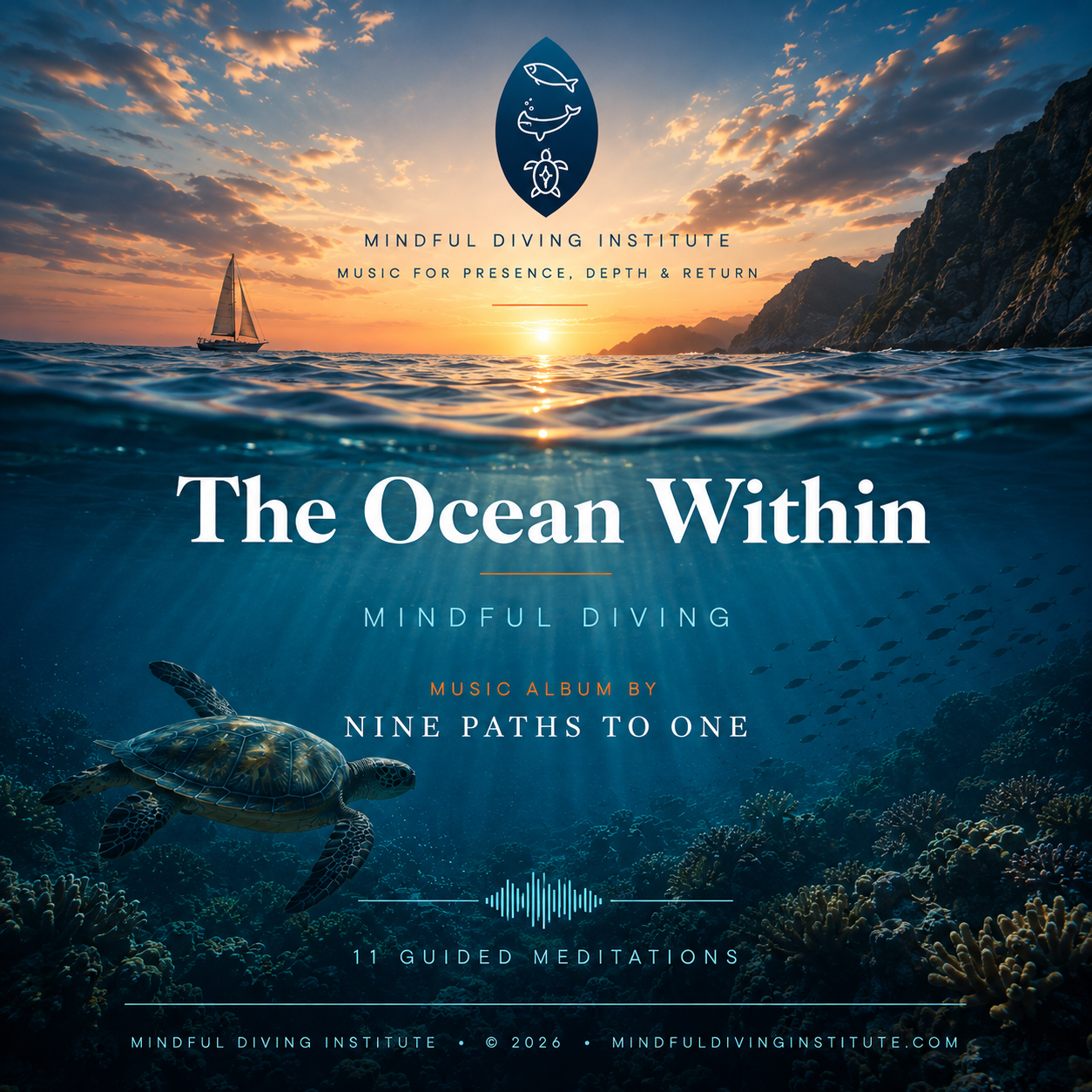
The Ocean Within · Nine Paths to One

The music of belonging

Our music carries the heart of MDI: arrive as you are, meet the ocean with respect, and carry care back into daily life. Technical learning and emotional awareness belong together, with connection to yourself, the water and life.

Listen, read the reflection or spend a moment in silence. There is no feeling to achieve and nothing personal to disclose. Listening is optional and does not affect course completion.

Listen on land, away from diving tasks. Breathe comfortably; you do not need to follow a musical rhythm or hold your breath. You can pause or stop at any time.

Original recordings in English and Spanish; reflections in your chosen language.

Make room for what you feel

Feelings can be noticed without being hidden or forced to change. A moment of listening may help us find words; silence, looking around or asking for support can serve just as well.

Meeting Fear at Depth

A moment to reflect

What feeling needs room, and what choice or support would help now?

Make room for what you feel

Feelings can be noticed without being hidden or forced to change. A moment of listening may help us find words; silence, looking around or asking for support can serve just as well.

Night Ocean

A moment to reflect

What feeling needs room, and what choice or support would help now?

Explore the music collection

From online access to certification

Your purchase activates the included learning. Certification requires completed learning, verified practice and the applicable assessment; attendance alone is not enough. PRO affiliation and teaching authorization are separate.

MD-2: 4 supervised water sessions in the published pathways.

What to agree with the center and PRO
  • MD-2: Confirm MD-1 readiness, complete advanced learning and water assessment. PRO-1 or PRO-2 within their verified agency rating.

Ask for a breakdown of online learning, instruction, logistics, taxes and extras; confirm who collects payment, the authorized instructor and weather/cancellation terms. If the package already includes your course, do not buy it again. Use your individual email for access and records.

The MD-1 to MD-3 certification fee is included for eligible center enrollments assessed by that center’s active, authorized PRO. Teaching is agreed separately.

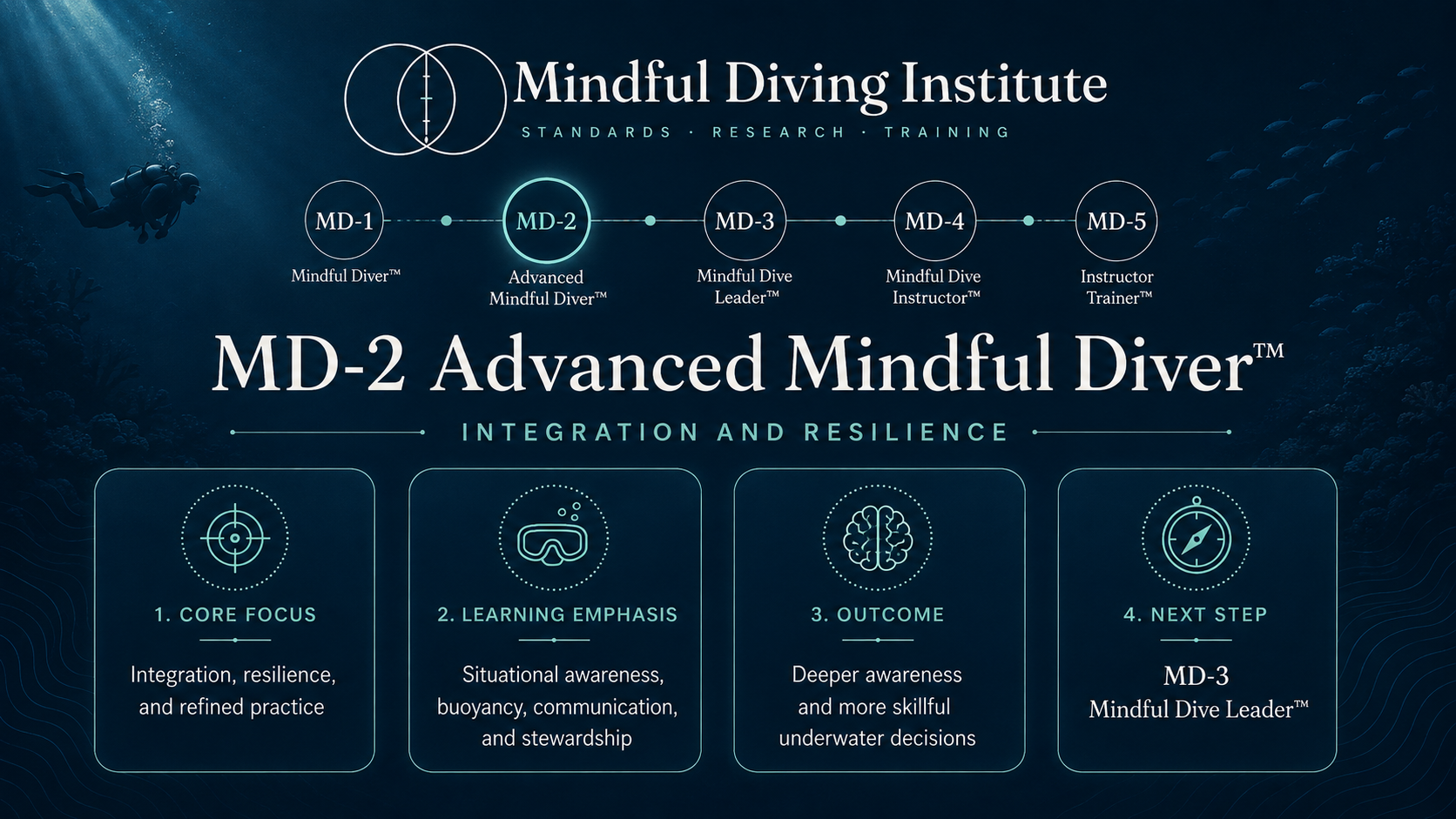
MD-2 level overview in the Mindful Diving Institute five-level pathway: core focus, learning emphasis, outcome and next step.

Modules

Loading…

Safety first

On scuba, breathe naturally and continuously as trained; never hold, skip or deliberately restrict your breathing. Keep attention on your buddy, buoyancy, gas and surroundings. Leave optional exercises out of descents, ascents and any demanding task.

Keep every practice within your training, agency standards and dive plan. Emergency procedures take priority. Anyone may decline a practice or end a dive. This is education, not therapy, medical clearance or agency endorsement.

Mindful Diving Institute

Explore related learning

Choose what you want to practise next. Everything here is optional; you can also revisit your course or use a free practice.

Prices cover online learning. Agree water sessions, practical assessment and professional affiliation costs separately before enrolling.

MD-3

Mindful Dive Leader™

Practise briefing a group, inviting concerns and debriefing decisions during supervised leadership training.

  • ≈ 10–12 h
  • 4 leadership dives

MD-3 requires MD-2 and a Divemaster qualification or equivalent from a recognized diving agency.

€222

Course details and prerequisites

MB-D

Mindful Breath Diver™

Explore breathing awareness and build a reflective practice through the 21 Breaths cycle.

  • ≈ 5–6 h
  • 21 Breaths cycle

€88

Mindful Breath Diver: €66 for eligible MD credential holders; eligibility is checked at checkout.

Course details and prerequisites

DM-F

The Diving Mind

Explore fear and doubt, rehearse a conversation and write your own dive-day plan.

  • ≈ 4 h
  • online only · no water sessions

€55

Course details and prerequisites

Prices cover online learning. Agree water sessions, practical assessment and professional affiliation costs separately before enrolling.