Waters of the World · Murcia, Spain
Diving in Cabo de Palos: the Marine Reserve, shoal by shoal
Off the Cabo de Palos lighthouse, a chain of drowned mountains rises from the seabed almost to the surface. It holds the best diving in the western Mediterranean. This guide covers where to dive, when, at what level, and how to do it with presence.
By Prof. Luis Miguel Gallardo · Mindful Diving Institute
Why it is called the best diving in the Mediterranean
The Cabo de Palos–Islas Hormigas Marine Reserve was created in 1995. It protects around 1,900 hectares around the chain of shoals running from the cape to the Hormigas Islands, including a no-take core where neither fishing nor diving is allowed.
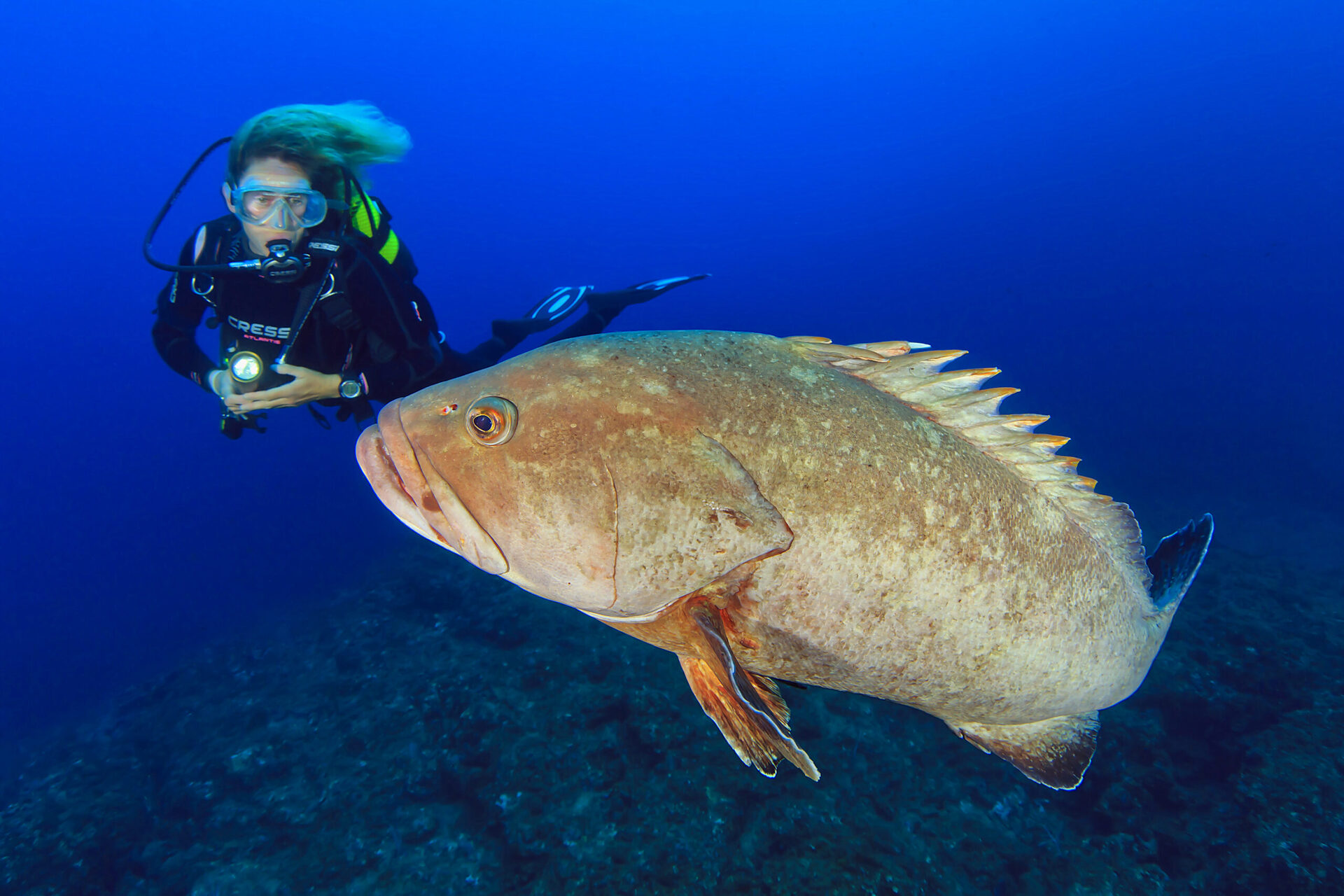
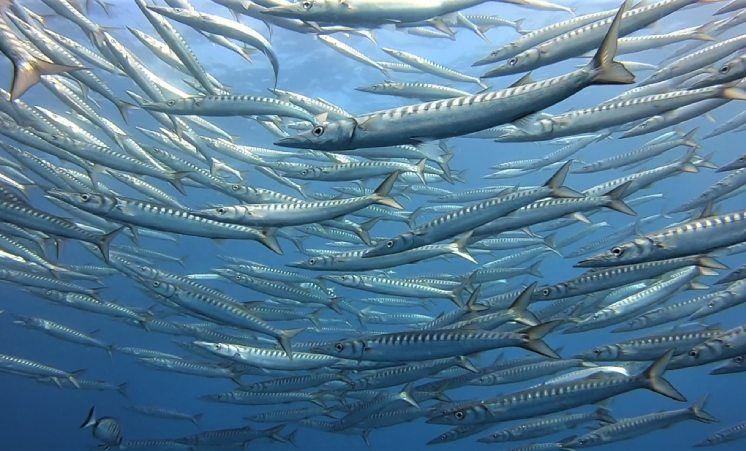
Three decades of protection have brought back something the Mediterranean had almost forgotten: large, unhurried fish. Groupers watching from their cracks, schools of barracuda turning over the shoal, dentex hunting in the current. Scientific studies of the reserve cite it as one of Europe's clearest examples of the reserve effect.
It is also a place of current and depth. That is why presence here is not decoration: it is the simplest way to dive safely and to truly see what is in front of you.
The main dive sites
Depths are approximate and depend on the route your guide chooses. Always confirm them at the center's briefing.
Bajo de Piles (I and II) · approx. 8–35 m
Walls and boulders with gorgonians, morays and groupers. It has shallow routes suitable for Open Water divers, which makes it the ideal first dive in the Reserve.
Bajo de Fuera · approx. 15–45 m
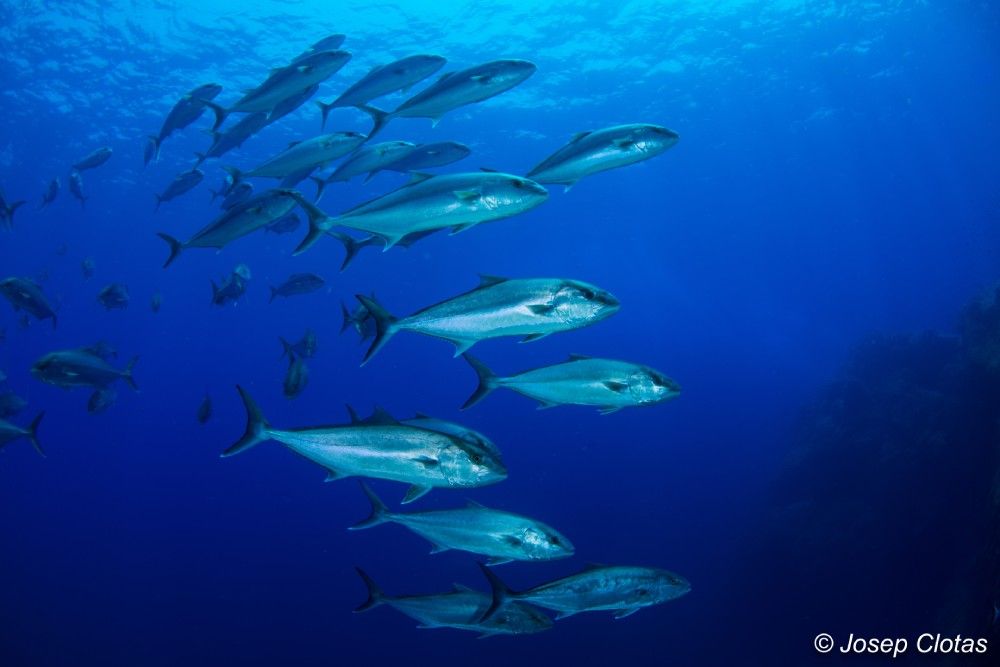
The outermost shoal and the most exposed to current. Big schools of barracuda, dentex, amberjack and, in season, eagle rays. Requires Advanced or deep training.
Bajo de la Morra · approx. 18–40 m
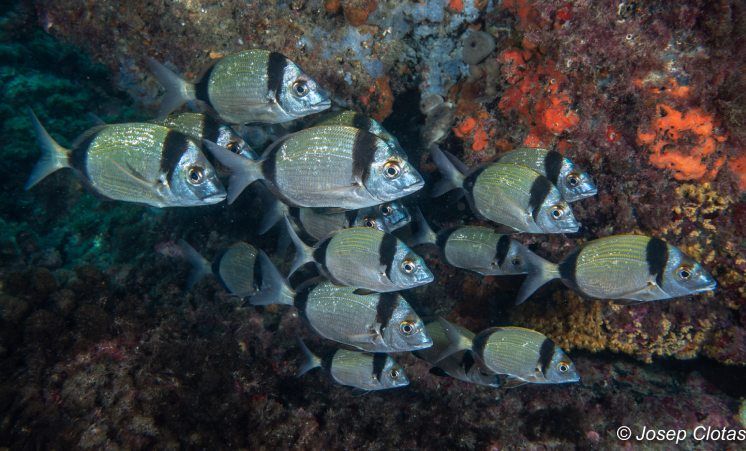
A pinnacle where life gathers around the rock: groupers, brown meagre and walls covered in colour. Advanced level.
Bajo de la Testa · approx. 15–40 m
Spires and canyons, with good pelagic traffic when the current runs. Advanced level.
Islas Hormigas · approx. 5–30 m
Around the island and its lighthouse: seagrass, boulders and cracks. Routes for several levels depending on the side dived.
Las Palomas · approx. 5–30 m
Isla de las Palomas, near Cartagena, offers a sheltered dive full of life: octopus, morays, salema and nudibranchs. Suitable for Open Water divers.
What you will see
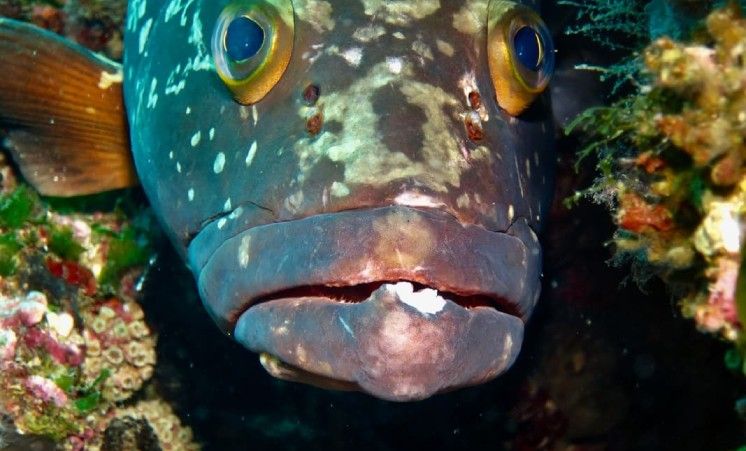
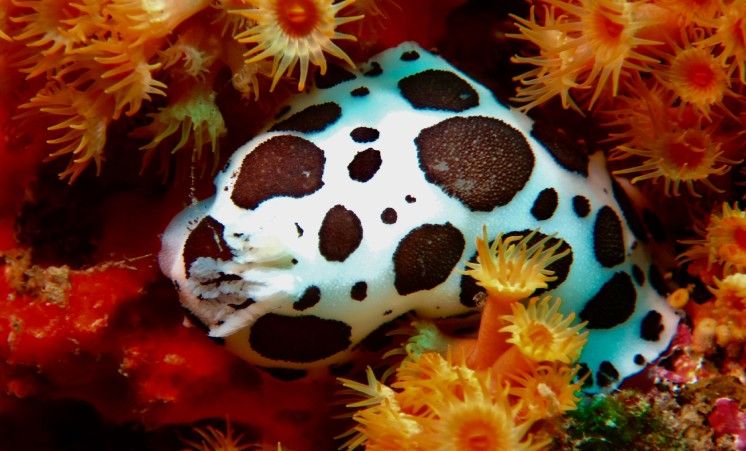
Large groupers, calm because of the protection. Schools of barracuda, dentex, amberjack and greater amberjack. Brown meagre, sea bream and morays in every crack. From late summer into autumn, with luck, eagle rays passing through. On the seabed, gorgonians, sponges and nudibranchs for anyone who looks slowly.
The rule is simple: look, don't touch. No feeding, no chasing. The stiller you are, the closer they come.
The wrecks of Cabo de Palos
Cabo de Palos is a coast of shipwrecks. Depths are indicative; all of them require planning and experience.
Naranjito · approx. 27–45 m
A freighter sunk in 1979 near Bajo de Fuera, almost intact on the sand. Advanced with a deep specialty and good buoyancy control.
Carbonero · approx. 35–45 m
A steam cargo ship on a sandy bottom, home to conger eels and groupers. Advanced deep level.
Sirio · approx. 40–70 m
The Italian liner lost on Bajo de Fuera in 1906. Its depth reserves it for technical divers.
Stanfield · approx. 55–65 m
A freighter resting deep off the cape. Technical diving only, with specific training.
Season and conditions
The best season is May to November. Water runs from about 14 °C in spring to 26 °C in late August and September; at depth there can be a thermocline even in summer. Visibility is usually 15–30 m.
Current and the easterly wind decide: some days the outer shoals cannot be dived. The center decides each morning. Bring a 5 or 7 mm wetsuit for most of the year and a hood in spring.
What level you need
With Open Water you can dive the shallow routes of Bajo de Piles and Las Palomas. Bajo de Fuera, la Morra, la Testa and the Naranjito and Carbonero wrecks need Advanced or a deep specialty, and the center will consider your recent experience. Sirio and Stanfield are technical dives.
If you have not dived for a while, start with a refresher. It is not a test: it is how you arrive at the shoal calm.
How to get there
Cabo de Palos sits at the southern end of La Manga del Mar Menor, in the Region of Murcia. By car: 25 minutes from Cartagena, 50 minutes from Murcia, 1 h 20 from Alicante and about 4 hours from Madrid. The nearest airports are Región de Murcia (Corvera) and Alicante-Elche.
Marine Reserve fees
The Reserve applies a fee of €5 per diver per dive, paid at the dive center. The number of daily divers is limited, and dives are booked in advance through authorised centers.
Our participating center: Planeta Azul
Planeta Azul is the Mindful Diving™ participating center in Cabo de Palos. It dives the Reserve every day and hosts our first event, Diving into Presence.
Paseo Dimas Ortega 24, 30370 Cabo de Palos · +34 968 56 45 32 · Instagram @planetaazul_cabodepalos.
Diving the Reserve with presence
The Mindful Diving™ arc has four phases. It fits entirely inside your dive plan and your agency's standards.
Before · intention and grounding
On the boat, heading out to the shoal: three slow breaths, an unhurried buddy check and one simple intention for the dive.
Below · presence in the water
Once stable at the foot of the shoal, let the grouper decide the distance. Slow, continuous breathing; no exercises during the descent, the ascent or gas management.
Between · the surface interval
Between dives, on the boat facing the lighthouse: a few minutes of quiet and one line in your logbook about what you truly saw.
Beyond · back on land
Take one thing into daily life: the way you breathed into the current, or the grouper's patience.
Next date
Next date · 6–9 November 2026
Diving into Presence in the Cabo de Palos Reserve
An event with Planeta Azul and the Mindful Diving Institute: dives in the Reserve and a presence practice before and after.
Keep exploring
Frequently asked questions
Do I need a certification to dive in Cabo de Palos?
To dive the Reserve you need a recognised scuba certification (Open Water or equivalent), and the center will ask for your card and logbook. Without one you can do a Discover Scuba dive with an instructor. The deeper shoals and the wrecks require Advanced or a deep specialty.
When is the best time to dive Cabo de Palos?
May to November. Water runs from about 14 °C in spring to 26 °C in late summer, and visibility is usually 15–30 m. September to November pairs warm water with fewer people.
How much does it cost to dive the Marine Reserve?
On top of the dive price charged by the center, the Reserve applies a fee of €5 per diver per dive, paid at the center. Daily places are limited to protect the seabed.
Can I try scuba (Discover Scuba) in Cabo de Palos?
Yes. Try dives take place in shallow, sheltered areas with an instructor beside you. Our Discover Scuba with presence is a full day with two dives and a practice before and after, and it counts toward MD-1.
What is mindful diving?
Mindful Diving™ is the first international standard uniting recreational diving, mindfulness and the science of wellbeing. It does not replace your agency: it adds a presence practice before, during and after every dive.
Every practice here fits entirely inside your agency standards and dive plan. Slow, continuous breathing only — never breath-holding, skip-breathing or hypoventilation on scuba. No exercise during descents, ascents or gas management. Mindful Diving™ is education, not therapy, and complementary to, and independent of, SSI, PADI, CMAS and RAID.